+86-136-0073-8328 nancy.huang@geotegrity.com
- All
- Product Name
- Product Keyword
- Product Model
- Product Summary
- Product Description
- Multi Field Search


Views: 0 Author: Site Editor Publish Time: 2026-08-28 Origin: Site


Single-use plastics face sweeping regulatory bans globally today. Foodservice operators urgently need reliable replacements. Styrofoam and standard paper often fall short during daily service. Transitioning to sustainable alternatives demands materials meeting strict compliance laws. Furthermore, these materials must never sacrifice operational performance. You need packaging capable of handling heavy grease, extreme heat, and dense portions.
Sugarcane bagasse sets the commercial standard for sustainable tableware today. However, procurement teams must understand its unique material properties thoroughly. This knowledge helps evaluate true durability and compliance accurately before bulk purchasing. We detail the exact composition of bagasse tableware below. You will discover how specific manufacturing processes dictate real-world performance. Finally, we provide a structured, procurement-focused framework. This guide helps you evaluate these eco-friendly products for large-scale commercial operations confidently.
Material Origin: Bagasse is the fibrous pulp left over after sugarcane juice extraction—an upcycled agricultural byproduct, not a virgin paper resource.
Structural Integrity: High-heat thermoforming creates a dense, cross-linked fiber matrix that resists water and oil naturally, making a bagasse plate highly durable for heavy or wet foods.
Versatility: The molding process easily accommodates complex shapes, from standard bagasse bowls for hot soups to specialized rectangular or multi-compartment trays.
Commercial Viability: Genuine bagasse products offer commercial-grade microwave and freezer safety while meeting strict BPI and EN 13432 compostability standards.
Understanding sustainable tableware starts at the source. We must define the raw ingredients accurately. True Bagasse Material is an agricultural byproduct. It is the dry, pulpy residue left over after factories crush sugarcane stalks to extract juice. Previously, sugar mills simply burned this residue. Now, engineers upcycle it into high-performance packaging.
The secret to its strength lies in plant biology. Sugarcane residue features an exceptionally high cellulose content. These specific fibers are noticeably longer and stronger than standard wood pulp. Longer fibers interlock more effectively during manufacturing. This inherent trait provides superior tensile strength. Operators notice this when handling dense meals. The tableware resists bending and snapping under pressure.
Corporate sustainability goals require measurable impacts. Sourcing this pulp requires zero additional land clearing. It utilizes existing agricultural waste. It rescues material that facilities would otherwise incinerate. Choosing these products directly supports corporate Scope 3 emission reduction goals. You drastically lower your supply chain carbon footprint. You also help prevent deforestation by avoiding virgin paper products.
Best Practice: Always verify the origin of your pulp. Genuine sugarcane residue should not blend with virgin tree fibers.
Common Mistake: Confusing it with standard recycled paper. Recycled paper lacks the long-fiber strength necessary for heavy food applications.
Raw plant fiber alone cannot hold hot soup. It requires advanced manufacturing to become commercial-grade tableware. The transformation relies on precision thermoforming engineering. We can break this complex manufacturing down into distinct phases.
First, facilities process the raw agricultural waste. They clean, boil, and beat the fibers into a pliable paste. Quality manufacturers avoid harsh elemental chlorine bleaching. They utilize Elemental Chlorine-Free (ECF) or Totally Chlorine-Free (TCF) processes instead. This ensures the final product remains safe for food contact and composting.
Cleaning: Removing dirt and residual sugars from the stalks.
Boiling: Breaking down raw lignin to soften the stalks.
Beating: Mechanical processing turns stalks into a uniform, wet slurry.
Next comes the core manufacturing step. Technicians pump the wet pulp into specialized molds. Heavy machinery presses the pulp at extreme temperatures. This process typically operates around 200°C. The intense heat evaporates remaining water instantly. It forces the long fibers to cross-link tightly.
This specific heat-pressing yields incredible results. It completely eliminates the need for plastic or wax linings. The resulting high-density surface naturally repels moisture. It easily handles hot oils up to 120°C. It manages boiling water up to 100°C safely. You get a single-material product performing like a plastic-lined container.
We must acknowledge material limits transparently. No natural fiber is invincible. These items are highly resistant to moisture. However, prolonged exposure to boiling liquids causes issues. If you hold boiling soup for over two hours, the fiber matrix softens. You must establish realistic operational expectations. Design your takeout service windows accordingly.
Traditional paper plates limit your presentation options. Factories stamp them from flat cardboard sheets. This severely restricts their depth and shape. Plant fiber manufacturing works entirely differently.
Because the process starts with a pliable wet slurry, shapes are limitless. Molds can create deep curves and sharp angles easily. This is not limited to flat designs. The slurry fills every crevice of a 3D mold before baking. A standard Bagasse Plate features reinforced rims purely because the mold design dictates it.
Consider the structural depth capabilities of molded fibers. A sturdy Bagasse Bowl maintains remarkable rigidity. It confidently holds heavy, hot, or liquid-based meals. You can serve thick soups, heavy curries, or massive burrito bowls safely. Furthermore, the trapped air within the fiber matrix acts as insulation. It prevents thermal transfer. This keeps the user's hands safe from unexpected burns.
Business-to-business (B2B) operations face strict spatial limits. Warehouse space costs money. Back-of-house storage is often cramped. Molded fiber products offer uniform nesting. They stack tightly together. This reduces your overall storage footprint significantly. They require far less shelf space compared to bulky rigid clamshells or foam containers.
Best Practice: Store inventory in a dry environment. High ambient humidity can slightly weaken stacked inventory over several months.
Modern menus demand complex packaging solutions. Standard round shapes do not always suffice. Advanced molding techniques allow for highly specialized configurations. These specific shapes solve distinct operational challenges.
Divided trays are essential for many foodservice sectors. They serve a very specific operational purpose.
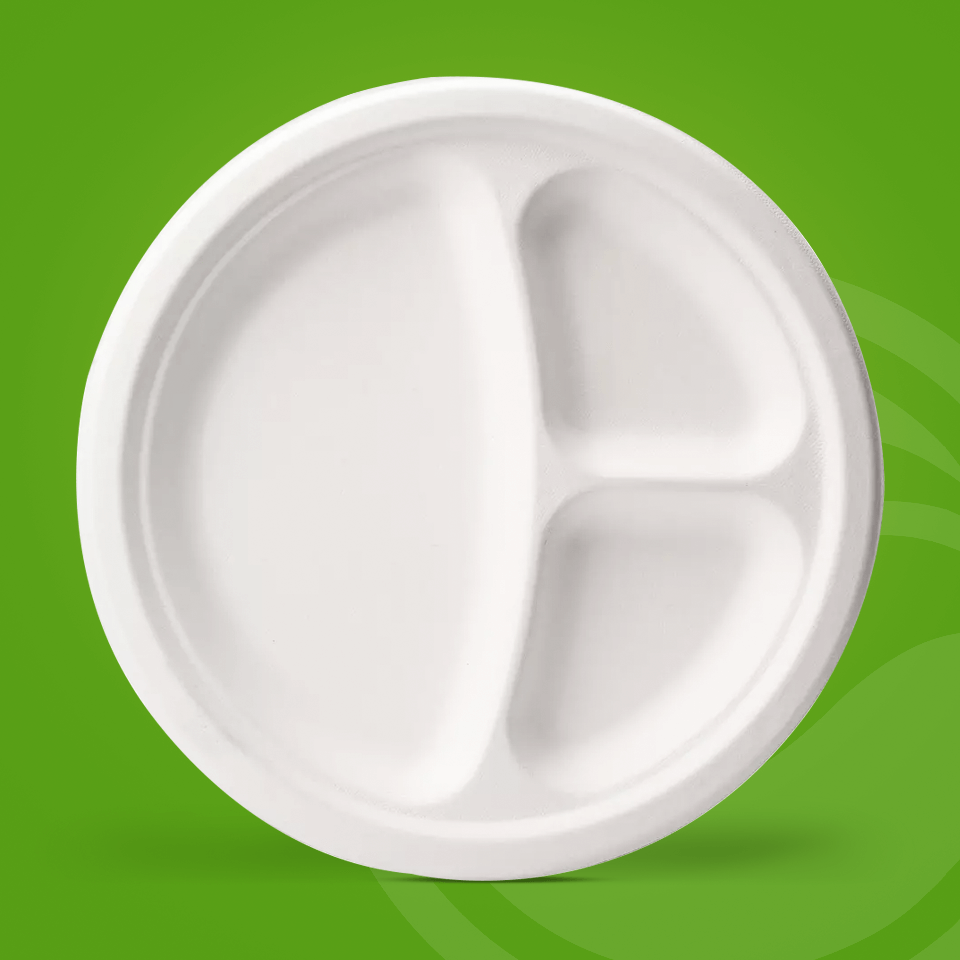
Operational Use Case: The 3-Compartment Bagasse Plate is ideal for cafeterias. It suits corporate catering and institutional dining perfectly. It manages diverse meal components effortlessly.
Performance Trait: The design features reinforced ridges between compartments. These ridges prevent wet and dry food migration. They keep sauces away from crispy items. Additionally, these internal walls add massive structural rigidity to the entire unit. The tray will not buckle under heavy mashed potatoes or wet vegetables.
Unique geometry can elevate your brand presentation immediately.
Operational Use Case: Foodservice brands choose a Rectangular Bagasse Plate for premium food presentation. It frames sushi, charcuterie, and high-end takeout beautifully. It also maximizes horizontal space on standardized cafeteria trays or inside square takeout delivery bags.
Performance Trait: Geometric molding relies on sharp, calculated angles. The manufacturing process ensures corners do not warp. The edges will not fold under the weight of dense, premium food items.
Making a procurement switch requires hard data. You must compare molded fiber against legacy materials directly. Operators need to know exactly how performance and economics align.
Styrofoam (Expanded Polystyrene) is cheap but highly problematic. First, it faces municipal bans globally. Second, EPS leaches toxic chemicals like styrene when microwaved. Molded plant fibers never leach toxins. They remain completely stable in microwaves. While EPS traps heat, it melts under extreme temperatures. Sugarcane fibers withstand high heat effortlessly while meeting modern environmental regulations.
Paper products have fatal structural flaws. Unlined paper absorbs grease immediately. It sags, leaks, and fails. To fix this, manufacturers use poly-coatings (plastic linings). Lined paper holds grease but ruins compostability. It belongs in a landfill. Sugarcane fiber offers a genuine single-material solution. It naturally resists grease without any hidden plastic films.
Unit economics dictate procurement decisions. Molded fiber carries a slightly higher upfront cost than basic plastic. However, this is only half the story. Cheap paper forces customers to use two or three items simultaneously. We call this "double-plating." Plant fiber prevents double-plating entirely because one unit is strong enough. It also aligns with premium brand positioning. Customers perceive greater value. This often results in overall operational savings and significantly higher customer satisfaction.
| Material Type | Grease Resistance | Microwave Safe | Compostable | Structural Rigidity |
|---|---|---|---|---|
| Sugarcane Bagasse | High (Natural) | Yes (Up to 3 mins) | Yes (Commercial) | Excellent |
| Styrofoam (EPS) | Moderate | No (Leaches toxins) | No | Good |
| Unlined Paper | Poor (Absorbs) | Yes | Yes (Backyard) | Poor (Sags easily) |
| Poly-Lined Paper | High (Plastic) | Varies | No (Landfill bound) | Moderate |
Purchasing at scale requires rigorous vetting. You cannot rely on marketing claims alone. B2B buyers must navigate complex regulatory landscapes. Use this targeted checklist before signing any supplier contracts.
Forever chemicals are a major liability. Older grease-proofing methods relied heavily on Per- and Polyfluoroalkyl Substances (PFAS). Regulators are actively phasing these chemicals out globally. Advise your procurement team to explicitly request PFAS-free or fluorine-free certifications. Do not accept outdated inventory.
The term "eco-friendly" is legally meaningless. You need verified compostability claims. Look for recognized independent certifications. Request BPI (Biodegradable Products Institute) certification in the US market. Look for OK Compost or EN 13432 certifications in Europe. These guarantee commercial compostability within a strict 60 to 90-day window.
Packaging touches what your customers eat. Confirm the necessity of food-grade manufacturing environments. Request ISO 22000 or HACCP documentation from the facility. Insist on reviewing recent toxicological safety testing results. This ensures zero heavy metal contamination.
Never buy a full pallet blind. Recommend requesting mixed sample packs first. Include bowls, compartments, and standard items. Conduct in-house stress tests immediately. Plate your specific menu items on the samples. Let them sit under heat lamps. Microwave them. Cut steaks on them. Only place bulk orders after the samples survive your real-world kitchen environment.
Best Practice: Always test acidic foods like tomato sauce. High acidity tests the limits of natural fiber grease resistance.
Common Mistake: Assuming all brown-colored products are sustainable. Color means nothing without proper certification documentation.
Switching to sustainable disposables is a strategic operational upgrade. Bagasse products are engineered sugarcane byproducts. They brilliantly solve the structural, thermal, and regulatory challenges facing modern food service. They eliminate toxic leaching and eliminate flimsy, sagging paper waste.
You must take decisive action today. First, audit your current disposable inventory meticulously. Identify which items fail most often. Next, map your specific menu items to the appropriate molded form factors. Finally, request strict compliance documentation from shortlisted suppliers. Equip your kitchen with materials that elevate your brand and protect the environment simultaneously.
A: Yes, they are highly microwave safe. They easily handle heating up to 2-3 minutes on high settings. The dense fiber matrix provides excellent thermal stability. Unlike Styrofoam, they never melt or leach harmful toxic chemicals into your food during the heating process.
A: No, they handle soup exceptionally well. The high-heat thermoforming process creates a natural, cross-linked barrier against water. They hold hot liquids securely for standard dining consumption windows. However, leaving boiling liquids in them for multiple hours will eventually soften the fibers.
A: The difference lies in raw material sourcing. Sugarcane residue is an upcycled agricultural waste product from sugar extraction. Bamboo requires dedicated harvesting, land usage, and more intensive mechanical processing to turn into pulp. Sugarcane utilizes existing waste, making it highly resource-efficient.
A: They are officially commercially compostable. They break down completely into nutrient-rich soil within 60 to 90 days inside commercial composting facilities. They are also naturally biodegradable in standard environments over time, though certified commercial composting guarantees the fastest, most effective breakdown.


