+86-136-0073-8328 nancy.huang@geotegrity.com
- All
- Product Name
- Product Keyword
- Product Model
- Product Summary
- Product Description
- Multi Field Search


Views: 0 Author: Site Editor Publish Time: 2026-08-26 Origin: Site


Rising consumer awareness regarding microplastics has fundamentally shifted modern food service priorities. Buyers now demand packaging solutions completely free from hidden synthetic polymers. However, navigating ESG compliance requirements requires more than just trusting surface-level marketing claims. "Eco-friendly" labeling frequently misleads well-intentioned procurement teams. You must differentiate between standard paper products hiding plastic liners, bioplastics like PLA, and pure plant-fiber solutions. True zero-plastic procurement demands rigorous material analysis. This guide deconstructs the manufacturing realities of sugarcane bagasse products. We address pressing concerns around microplastics, chemical additives, and performance coatings. You will learn how to verify supplier claims and implement safe packaging alternatives. Ultimately, this knowledge supports evidence-based procurement decisions for your entire distribution network.
Pure sugarcane bagasse contains absolutely no petroleum-based plastics or microplastics; it is 100% natural organic fiber.
Historically, some molded fiber products relied on "forever chemicals" for grease resistance, making the specification of a PFAS-Free Bagasse Tray or bowl critical for compliance.
For liquid retention, modern manufacturers are replacing bioplastic (PLA) liners with advanced aqueous coatings, creating the truly plastic-free Water-Based Coated Sugarcane Cup.
Validating plastic-free claims requires specific documentation, including BPI certification, FDA compliance data, and independent laboratory testing for fluorine content.
Understanding true sustainability begins by examining material origins. Bagasse is the fibrous residue left after sugarcane stalks undergo crushing for juice extraction. It serves as a prime example of agricultural upcycling. The raw material consists entirely of cellulose, hemicellulose, and lignin. It is inherently free of synthetic polymers. You will not find any petroleum derivatives hidden within the raw plant fibers.
The manufacturing process relies entirely on mechanical physics and water. Factories wash and pulp the raw fibers into a dense slurry. They then pump this wet pulp into custom molds. Machines thermoform the material into shape using extreme high heat and intense pressure. The natural lignin inside the sugarcane acts as an organic binder. No chemical glues or plastic resins are necessary to hold the structure together. This guarantees a remarkably pure structural foundation.
This purity dictates the final end-of-life outcome. Because it consists of pure biomass, an uncoated Bagasse Bowl biodegrades naturally in the environment. Soil microorganisms consume the cellulose efficiently. They leave behind zero microplastic residue in soil beds or commercial compost facilities. We consider this a closed-loop organic cycle. It completely eliminates the persistent environmental contamination associated with synthetic disposable tableware.
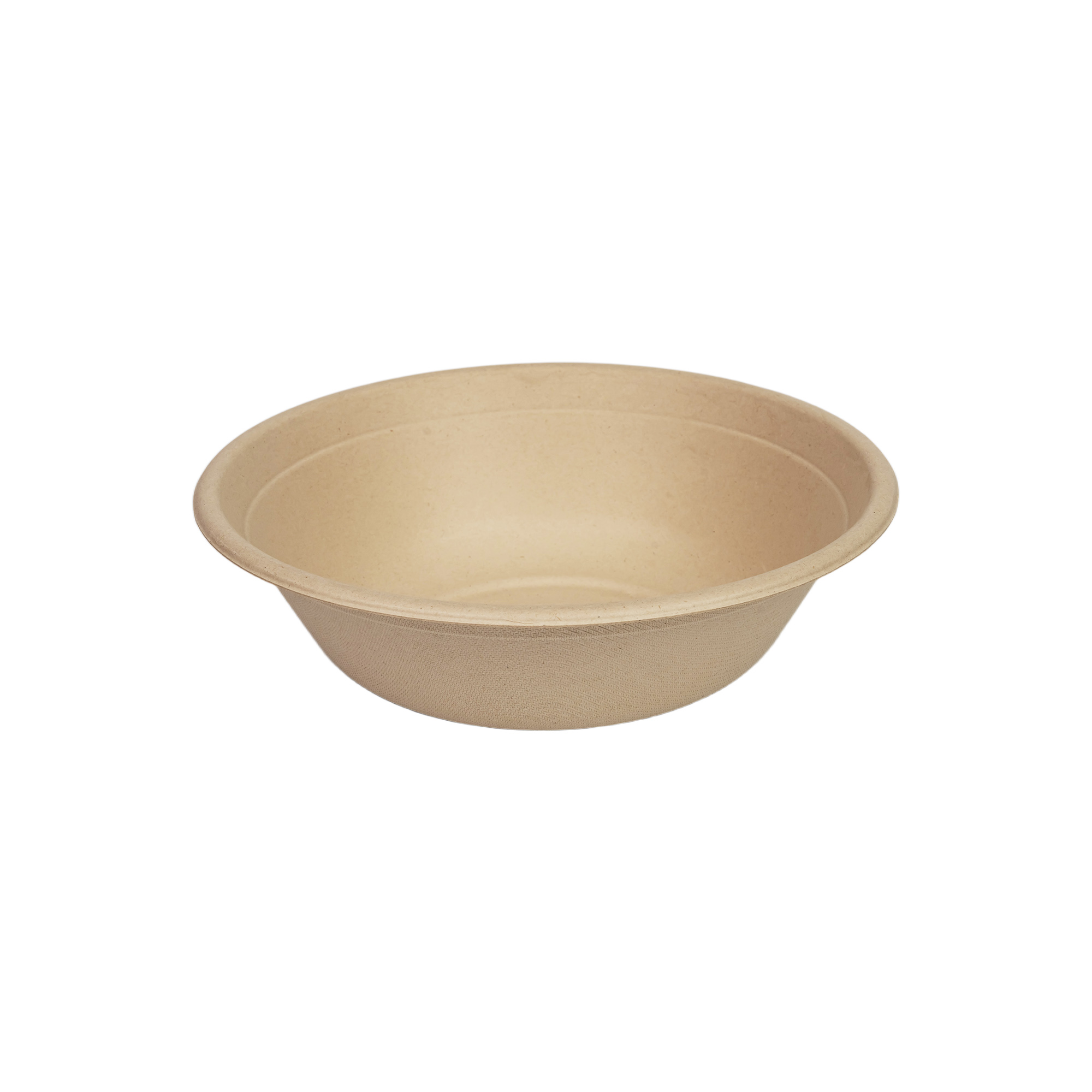
Food service operators often confuse molded fiber with traditional paper products. The problem with standard paper cups and bowls is their inherent porosity. Traditional paper requires polyethylene (PE) or polypropylene (PP) inner linings to prevent immediate leaks. These laminated plastic films never truly biodegrade. They fragment over time. They eventually break down into harmful microplastics polluting our waterways and soils.
Early-generation eco-tableware attempted to solve this using Polylactic Acid (PLA). Some bioplastic nuances make PLA problematic today. While derived from fermented plant sugars, PLA behaves exactly like a conventional plastic. It requires aggressive industrial facilities to compost effectively. Temperatures must exceed 60 degrees Celsius for extended periods. Most municipalities lack these specialized composting infrastructures. Consequently, PLA does not align with strict "plastic-free" definitions emerging in global legislation.
In contrast, pure molded fiber offers unique functional properties. Unlined Bagasse Cup products naturally resist water to a limited degree. This occurs due to the extreme density of the pressed fiber matrix. The tight molecular packing slows moisture penetration significantly. This makes them highly safe and microplastic-free for short-term food contact. You can confidently serve dry goods, salads, and quick-serve items without worrying about hidden polymer films.
Natural plant fibers possess excellent structural strength but struggle against heavy fats. The grease resistance trade-off has plagued the molded fiber industry for years. To prevent heavy oils from soaking through natural fibers, manufacturers historically relied on chemical additives. They added Per- and Polyfluoroalkyl Substances (PFAS) directly into the wet pulp. These chemicals created an invisible, highly effective barrier against grease and moisture.
We must understand why this matters now. PFAS molecules feature incredibly strong carbon-fluorine bonds. They do not break down in nature. They are now facing strict global bans across North America and Europe. Severe consumer backlash continues to grow due to their environmental persistence. Medical research links continuous PFAS exposure to various adverse health risks. You cannot market a product as sustainable if it leaches forever chemicals into compost soils.
Fortunately, the industry has responded rapidly. Evaluating modern alternatives reveals significant technological leaps. Advancements in mechanical pulping techniques create tighter fiber meshes. Manufacturers now incorporate organic sizing agents derived from plant starches. These innovations have eliminated the need for toxic fluorinated chemicals. Modern tableware provides exceptional oil holdout using completely natural chemistry.
| Technology Era | Primary Additive | Environmental Impact | Regulatory Status |
|---|---|---|---|
| Legacy Generation | PFAS (Fluorinated Chemicals) | Highly persistent, contaminates compost | Banned in major global markets |
| Transition Generation | Short-chain PFAS (e.g., PFOA-free) | Still leaves chemical residues in soil | Facing phased-out restrictions |
| Modern Generation | Plant-based Sizing Agents | 100% natural, fully compostable | Fully compliant and universally accepted |
Your verification strategy must be uncompromising. Procurement teams must explicitly request proper documentation. You must demand proof showing the product is a certified PFAS-Free Bagasse Tray. Do not accept vague assurances from suppliers. Ask for independent third-party laboratory testing. The accepted industry standard requires total fluorine testing to read below 100 parts per million (ppm).
While unlined bagasse handles dry and moderately moist foods perfectly, limits exist. The scalability problem emerges in high-demand beverage scenarios. High-heat liquids and extended use-cases expose the natural limits of unlined fiber. Think about serving boiling hot soups or holding black coffee for an hour. The natural fibers will eventually absorb the liquid, soften, and lose structural integrity. We needed a sustainable solution for extended liquid retention.
The aqueous solution represents a massive breakthrough for food service packaging. The industry standard is shifting aggressively toward the Water-Based Coated Sugarcane Cup. This technology avoids lamination entirely. Instead, it uses a liquid barrier formulated from natural resins and water-based polymers. Manufacturers spray or dip the fiber into this dispersion. As it dries, it forms a microscopic protective network embedded directly into the fiber surface. These coatings contain absolutely zero microplastics.
Evaluating performance versus compliance highlights why this technology is superior. Aqueous coatings provide the structural integrity you expect from a PE or PLA lined cup. They prevent sweating, leaking, and premature softening. Yet, they dissolve entirely during standard composting processes. The natural polymers break down alongside the sugarcane fibers. This maintains total compliance with the strictest plastic-free legislation worldwide.
Switching to sustainable tableware requires a methodical approach to vetting suppliers. You cannot rely on marketing buzzwords like "green" or "earth-friendly." Proper due diligence begins with recognized international standards. Look for BPI (Biodegradable Products Institute) certification in North America. Seek OK Compost (Home or Industrial) marks in European markets. Ensure the products meet EN 13432 standards for compostability. These bodies verify the absence of heavy metals and guarantee complete material disintegration.
We recommend using a strict supplier transparency checklist during your vendor selection process. Follow these exact steps to ensure full compliance:
Request detailed Safety Data Sheets (SDS) for all raw materials and coatings.
Ask for specific testing reports from accredited labs regarding total fluorine content.
Verify the exact type of coating used on the product line.
Ensure the manufacturer clearly distinguishes between Uncoated, PLA-lined, and Water-Based options.
Finally, you must address practical implementation risks before rolling out new packaging. Always test samples under real operational conditions. Expose the containers to commercial heat lamps for extended periods. Microwave them with oily foods to monitor structural changes. Subject them to prolonged moisture exposure in standard kitchen environments. You must ensure the plastic-free alternative meets your existing baseline performance criteria without fail.
Bagasse tableware naturally consists of pure sugarcane fiber, making it inherently free of conventional plastics and harmful microplastics.
Procurement teams must look past surface-level environmental claims and rigorously evaluate the specific chemical coatings used in manufacturing.
Audit your current disposable inventory immediately to identify any hidden PE/PLA liners or legacy PFAS chemical treatments.
Shortlist reliable suppliers who willingly provide transparent documentation for unlined or certified water-based coated bagasse solutions.
Request commercial samples and conduct extensive in-house stress testing to validate performance before committing to a full operational transition.
A: Yes, pure bagasse bowls are completely microwave-safe. They withstand high heat efficiently without warping or melting. They do not leach toxic chemicals or microplastics into your food when heated. This makes them a vastly superior alternative to traditional polystyrene (Styrofoam) or standard plastic takeout containers.
A: Biodegradable means a material will eventually break down in nature over an unspecified time. Compostable means it will break down into nutrient-rich soil within a specific timeframe (usually 90-180 days). This happens under designated temperature and moisture conditions. Pure bagasse meets strict global compostability standards.
A: No. High-quality, properly refined sugarcane pulp is completely odorless and tasteless. The thorough washing and high-heat thermoforming process removes any residual agricultural scents. This ensures the packaging does not impact the delicate flavor profile of your hot or cold menu items.
A: Aqueous-coated bagasse is specifically engineered for demanding commercial food service environments. It typically holds boiling hot liquids safely for 12 to 24 hours. You will experience no structural failure, exterior sweating, or paper degradation during standard consumption timeframes.


