+86-136-0073-8328 nancy.huang@geotegrity.com
- All
- Product Name
- Product Keyword
- Product Model
- Product Summary
- Product Description
- Multi Field Search


Views: 0 Author: Site Editor Publish Time: 2025-11-11 Origin: Site


In the global movement toward sustainable packaging, the compostable coffee cup has become a symbol of eco-conscious living. From coffee chains to small cafés, more businesses are turning away from plastic-lined paper cups in favor of biodegradable alternatives. Among these, the 8oz bagasse cup—made from sugarcane residue—has emerged as one of the most sustainable and practical solutions. But how much environmental benefit does it truly offer? To understand the real impact, we need to quantify its contribution to carbon footprint reduction and explore how its life cycle compares to that of traditional disposable cups.
Every year, hundreds of billions of single-use cups are consumed globally. Most of them—whether made from paper, plastic, or polystyrene—end up in landfills or incinerators. A standard paper coffee cup, despite its seemingly natural appearance, typically contains a polyethylene (PE) plastic lining, which prevents leakage but makes recycling difficult. These cups take decades to decompose and release greenhouse gases (GHGs) such as carbon dioxide (CO₂) and methane (CH₄) as they break down.
The carbon footprint of a traditional disposable coffee cup includes emissions from:
Raw material extraction (e.g., logging for paper or oil refining for plastics)
Manufacturing energy consumption
Transportation and distribution
Waste management (landfilling, incineration, or recycling)
A life-cycle analysis (LCA) often reveals that a conventional 8oz paper cup can generate about 60–80 grams of CO₂ equivalent (CO₂e) over its entire lifespan. While that may seem small, multiplying it by billions of cups creates a significant environmental burden.
A compostable coffee cup differs fundamentally from a recyclable or biodegradable one. Compostable materials are designed to break down into natural elements—carbon dioxide, water, and organic matter—within a specific timeframe under composting conditions, leaving no toxic residues.
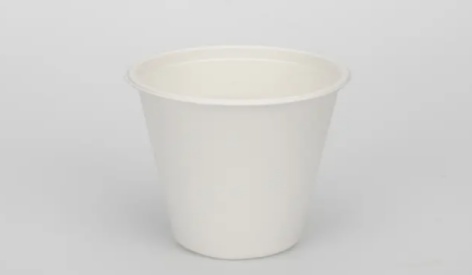
The 8oz bagasse cup is made primarily from bagasse, the fibrous byproduct of sugarcane juice extraction. Rather than burning or discarding this residue, manufacturers repurpose it into pulp that can be molded into tableware, food containers, and cups. Bagasse is fully compostable in both industrial and home composting environments, typically decomposing within 90 days under optimal conditions.
Key features of compostable bagasse cups include:
Renewable raw materials: Sugarcane regrows annually and absorbs CO₂ during cultivation.
No plastic lining: Many bagasse cups use a PLA (polylactic acid) coating derived from corn starch—also compostable.
End-of-life biodegradability: These cups turn into compost that enriches soil health.
This closed-loop approach transforms agricultural waste into functional packaging and, ultimately, into a nutrient source for new crops—a true model of the circular economy.
To fully understand the environmental benefits of the 8oz bagasse cup, it is essential to examine its entire life cycle, from raw material sourcing through production, transportation, and end-of-life disposal. Each stage contributes to its overall carbon footprint and sustainability profile, highlighting why bagasse cups are a more eco-friendly alternative to conventional disposable cups.
The production of bagasse cups begins with sugarcane cultivation. Sugarcane naturally absorbs approximately 1.6 kilograms of CO₂ for every kilogram of dry biomass produced. The bagasse used for cups is a byproduct of sugar extraction, meaning it requires no additional planting, fertilization, or energy-intensive cultivation. Only collection, drying, and transport to the manufacturing facility are needed. Because bagasse offsets emissions that would otherwise be associated with waste disposal or fossil-based alternatives, it is considered a carbon-negative feedstock. This stage provides a strong environmental advantage compared to virgin paper or plastic, which require significant raw material extraction and processing.
Transforming bagasse into a finished cup involves cleaning, pulping, molding, drying, and finishing. These steps do require energy, but the footprint is substantially lower than that of producing conventional paper cups with polyethylene linings or plastic cups. Modern bagasse cup factories increasingly employ renewable energy sources, such as biomass boilers or solar power, further reducing emissions. On average, manufacturing a single 8oz bagasse cup generates 10–20 grams of CO₂e, depending on the facility’s energy efficiency and production methods. Additionally, the use of water-efficient pulping techniques and minimal chemical additives ensures reduced environmental impact.
Bagasse cups are lightweight, which minimizes fuel consumption during shipping. Their compact design also allows for high-volume transport, reducing the number of trips needed. In most local or regional supply chains, transportation emissions are relatively minor compared to raw material and manufacturing phases, but they still benefit from optimized logistics, including bulk shipping and eco-friendly transport methods.
The most significant environmental advantage comes at the end of the cup’s life. Bagasse cups are fully compostable, decomposing within weeks under industrial or home composting conditions. The resulting compost enriches soil, enhances nutrient cycling, and reduces reliance on synthetic fertilizers, providing indirect environmental benefits. Even if a bagasse cup is accidentally landfilled, it produces fewer greenhouse gas emissions than traditional plastic or plastic-lined paper cups, thanks to its organic composition and absence of fossil-based polymers. This contrasts sharply with conventional cups, which can take decades to degrade and release methane, a potent greenhouse gas, in the process.
Comparing life-cycle data provides a clear picture of how much better the bagasse cup performs environmentally. Let’s consider a simplified analysis for an 8oz serving cup.
Lifecycle Stage | Traditional Paper Cup (g CO₂e) | 8oz Bagasse Cup (g CO₂e) | Emission Reduction (%) |
Raw Material Extraction | 25 | 5 | 80% |
Manufacturing | 30 | 15 | 50% |
Transportation | 10 | 8 | 20% |
End-of-Life (Decomposition/Composting) | 10 | 2 | 80% |
Total Carbon Footprint | 75 g CO₂e | 30 g CO₂e | ≈60% Reduction |
This simplified life-cycle assessment suggests that using an 8oz bagasse cup can reduce carbon emissions by up to 60% compared to a conventional paper cup with a plastic lining. If a coffee shop serves 1,000 cups per day, switching to bagasse could save approximately 45 kg of CO₂e daily, or over 16 tons annually—equivalent to planting around 800 trees.
Bagasse cups significantly lower landfill waste. Since they degrade naturally, they don’t occupy landfill space for decades like plastic-lined cups. Compostable disposal also avoids methane emissions, a potent greenhouse gas.
The bagasse industry provides value to sugarcane farmers by monetizing agricultural residues that would otherwise be discarded or burned. This reduces open-field burning, improving air quality and reducing soot emissions.
Producing bagasse pulp generally consumes 30–40% less water and energy than manufacturing virgin wood pulp. Additionally, bagasse cups can be made using unbleached materials, minimizing chemical pollutants.
When composted, the organic matter from bagasse cups enhances soil fertility, water retention, and microbial activity—closing the sustainability loop between consumption and regeneration.
While sustainability is often viewed as a moral imperative, adopting compostable coffee cups also brings tangible business advantages.
Consumers increasingly favor brands that prioritize sustainability. Offering compostable coffee cups signals environmental responsibility and enhances brand loyalty, especially among younger, eco-conscious demographics.
Many countries and cities are phasing out single-use plastics. Using certified compostable cups (meeting EN13432, ASTM D6400, or BPI standards) ensures compliance with these evolving environmental laws.
Compostable packaging can lower waste management expenses by diverting organic waste from landfills into composting systems. Businesses that partner with composting services often benefit from reduced waste fees.
Cafés, restaurants, and corporate offices can use compostable packaging as a unique selling point, distinguishing their brand from competitors that still rely on conventional disposables.
Despite the advantages, misconceptions still exist about compostable packaging.
“Compostable means it breaks down anywhere.”
Compostable cups require specific conditions—heat, moisture, and oxygen—to degrade properly. Industrial composting facilities provide ideal environments, though many bagasse products can also break down in home composters over several months.
“They’re too expensive.”
While unit costs may be slightly higher, total ownership costs often balance out when considering reduced waste fees and improved brand value. Moreover, as production scales, the price gap continues to narrow.
“Composting isn’t widely available.”
Composting infrastructure is expanding rapidly worldwide. Even where industrial composting is unavailable, bagasse cups still outperform plastics in decomposition and toxicity.
The 8oz bagasse compostable coffee cup is more than just a green alternative—it represents a measurable reduction in carbon emissions, energy consumption, and waste. By replacing traditional paper or plastic-lined cups, businesses can cut their packaging-related carbon footprint by more than half, contributing meaningfully to global climate goals.
In essence, every cup matters. When multiplied across millions of coffee servings, the collective impact becomes profound. Choosing compostable cups is not just an act of corporate responsibility; it’s a practical, quantifiable step toward a cleaner planet and a circular economy.
For companies, retailers, or coffee brands looking to transition to compostable packaging solutions, it’s worth exploring suppliers who specialize in high-quality bagasse products. One reliable partner is GeoTegrity Eco Pack (Xiamen) Co., Ltd.—a manufacturer known for its innovation in sustainable packaging and commitment to environmentally responsible materials. Their range of compostable tableware and beverage containers provides both ecological and economic benefits for businesses aiming to go green without compromising quality.


